Thriller Opening Sequences
To get more information on films of the thriller genre for my Portfolio project my group members and I have conducted research on film openings. Each of us researched two which is 6 in total, but I will only be introducing 5 of them. We all know that our genre thriller has a specific audience(25 and older) as younger audiences tend to not be able to handle the twists and turns.

Run
The 2 minute 30 seconds opening sequence is a prologue using the conventional flashback method.
MES- The setting is a gloomy hospital with low-key lighting enough to see the doctors whatever they are working on. It stayed the same until the second shot. Then in the third shot it gets brighter as there are more lights. In the last shot the lighting goes back to lowkey to build suspense and give an eerie vibe.
CIN- Camera slowly gets closer in to build suspense in the first shot. In the second shot the camera is in Steadicam and the doctor appears. In the third shot there is a slow tilt up as the doctor is pushing the mother to her child. In the fourth shot the camera is steady, but the mother gets closer as she wishes to see her child.
Editing- Cutting on action from the third to fourth shot. During most of the opening sequence there were just cuts. There was a cut near the end of the last shot where the woman turned to look at the doctors and it cuts to black. The J and L cut is also used to make the music transitions smoother.
Sound- Beginning starts with high pitched music that builds up gets to its highest and goes back to the beginning process. You can also hear the monitor thing beeping and the doctors talking. One of them specifically saying, “One, two, three and repeats.” It slowly fades away and muffled talking takes over. This continues until the second shot. In the next shot it goes silent. Stringy music is then played and is built up until the mother sees her newborn baby. Uplifting music starts to play once the mother touches the glass. You can hear the beeping in the background while this is all going on. Deep eerie music than comes back on when the mother says, “Is she going to be, okay?” This music builds up then it cuts to the next scene where the opening sequence ends.
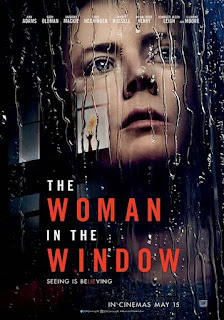
The Woman in the Window
The 2 minute 54 seconds opening sequence is a prologue using the conventional dreams method.
MES- In the first shot there was not much lighting besides the little balls of light which are used to get the viewer to feel lost or unaware of where they are. The second shot had brighter lighting most likely to make the eye pop out more during this specific shot. The lighting in this shot makes the scene look more angelic and eye opening. The third to fourth shot pan begins the lighting fades away and it looks like the scene is slowly dying. In the fifth shot lighting is lowkey, but light slowly creeps in as a stairwell is revealed. The lighting then becomes lowkey once again in the next shot but brightens up right after as the shot shifts to a pan of a room with lighting that looks to be morning. In shot 13 the lighting is lowkey tracking a cat which slowly leads into a pan into a living with brighter lighting. We then see the woman looking at the man outside bringing in boxes early in the morning. After the back-and-forth shots, the camera is looking at the woman’s back with the setting going back to the living room with lowkey lighting and a bit of sunlight from the window the woman is looking at.
CIN- In the second shot there is an extreme close up on the character’s eye. Third shot is a landscape shot also known as a long shot. The still camera then goes into a pan still in the same shot. Fourth shot is a slow tilt up to reveal a very tall staircase. Fifth shot is a pan going into the sixth shot with a medium shot as well as a pan. The seventh shot is very brief but is a close up on the woman’s hands grabbing pills. The eighth shot is a continuation of the last shot where the woman takes the pills. Ninth shot is a zoom in on what looks to be a bedroom. Shot 10 is a close up pan of a kid drawing on a chalkboard. Next shot is a close up of the woman letting in the mail carrier for a delivery. Eleventh shot is a medium-close up of the man dropping the package off. Next shot is very brief, but it shows the woman giving the mail carrier the money through a little slot in the door. Shot 13 is POV shot as well as a tracking shot as the camera is in the eyes of the woman, and she is focusing on the new neighbor bringing in boxes. The next shot is a close up of the woman’s facial expression while looking at the neighbor. Then in the next shot there is a long shot of a living room with the woman on the left side.
Editing- There is a quick cut from the first shot of black with white speckles. From the second shot there is a cut that is so smooth you can barely see it. All the way until the seventh shot I believe. There is a cutting on action from shot 7 to 8 the woman grabs the pills, and it cuts to her swallowing the pills and drinking water. Near the end of the opening scene there is back and forth editing from the woman staring at her neighbors to the shot with the neighbors moving boxes in. For the rest of the opening sequence there were just a series of cuts and quick cuts.
Sound- In the first shot the camera is twist, turning and spinning in sort of a galaxy setting and near the end you can hear a woman breathing heavily. The breathing gets deeper, and the woman is taking deeper breaths. There is also very high-pitched stringy music in the beginning as well as a subtle wind sound that builds up when the first shot is close to ending. In the second shot the woman gasps then begins breathing with a much faster pace. Third shot you can hear children playing and a deep eerie music that is constantly playing throughout the next few shots. Then the music builds up and stringy instruments jump into the mix making the next shot even more uncomfortable. You can then see and hear a computer beeping. The sounds of the kids come back into play, but this time when they are playing you can hear one little kid that screams. The music continues, but then you can hear a voiceover between a mother and her child. Then the conversation goes to the woman and her husband as the kid runs calling to his dad for a pumpkin.
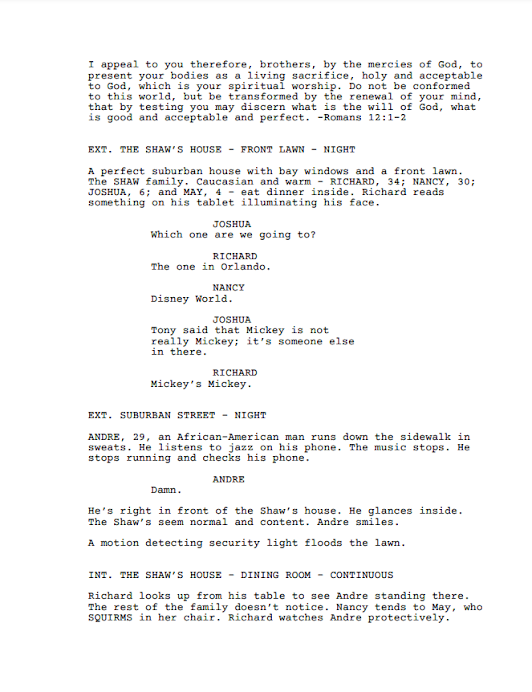
Get Out
The 2 minute 41 second opening sequence is a prologue using the conventional flashback method.
MES-
-dark outside/night time
-streetlights seems to be the only lighting
-in a suburban community
-character wears a blue shirt with a leather jacket and jeans average outfit
-he looks like he doesn’t want to be there
-the other man was wearing all black and a mask
CIN-
In the first shot the beginning showed the camera zooming out and goes into a long shot as he walks into the frame, to a medium while he gets closer to the frame, to a close up when he’s looking for an address then back to medium shot which is carried out through the rest of the shot, there is also tracking used and as he gets abducted towards the end of shot 1 it goes into an extreme long shot.
Editing-
Cutting on action is used when the abductor is dragging him to the car this would show what’s happening from a different angle.
Sound-
Diegetic sound from crickets at the start of shot 1 to the sound of the car in the middle of the shot, the conversation over the phone, him talking to himself. As he notices the car stopping by him the radio in the car starts to play and as the scene goes on it gets louder making it background music which is non diegetic with the music playing in the background while he gets abducted intensifies the tension and suspense.
Flatliners
The 2 minute 35 second opening sequence is a prologue using the conventional flashback method.
CIN-
-the first shot is of looking out of the window of a moving car in soft focus. The camera itself is still.
-Shot 2 is a behind the head full shot of a blonde girl. Behind the head shot creates a mysterious effect since the view is unable to identify the character.
-Shot 3 shows another single shot close woman driving from a behind angle. It is another behind the head shot slightly because we are unable to see her face as well. This contributes to the building tension and the unknown of the characters
-Shot 4 is a two shot of both females in the front seats of a car. The camera is placed on the left side of them. The shot gives us a close up of the women in the driver’s seat (dark hair) face. She is slightly out of focus while the blonde child in the seat next is her is in shallow focus. Their faces are now visible which decreases the tension within the opening.
-shot 6 changes to a single eye-level medium close –up shot of the dark hair women driving.
-The camera switches to a single eye-level close up of the young blond girl.
-In shot 9 the use a dolly in on the young blonde girl in the passenger seat. This is to convey something is about to happen to her.
-Shot 10 is a single shot close up of the dark-haired women. They use a close up to emphasize the look of panic she has on her face while glances to her lap and back to ride like she is distracted.
-The next 6 shots (11-17) show different angles of a car crashing off the side of the road. They use POV shots from the front windshield of the car. They also use low angles and full shots of the car flipping over the bridge.
-Shot 18 and 19 were close ups of what looks like an operating room. This gives insight to film that it relates to a hospital that experiences a lot of life and death.
-Shots 19 and 20 use a cut-in from a full to a close shot of a dead body on an operating table.
-shots 21 and 22. Show various aspects of a cemetery using eye-level shots of the tombstones jump cuts.
-Shots 19-25 are jarring, very quick jump shots.
-The outer edges of the shots of blurry making it pay close attention to what is in crisp focus.
-Shot 28 is a pan up at the foot of a Mortuary table.
Editing
-The first 1-4 shots cut away to credit scenes and back to the main storyline.
-The credits screens are a plain black background with off white coloring of the font. There are slight green and blue streaks quickly appearing and disappearing.
-Shots of (11-17) are jump cuts of the car crashing.
-The title of the opening zooms out. The font looks as if it is beating to the beating like a heart.
-Shot 25 transitions to 26 using a zoom in dissolve effect almost going from a full shot of a cemetery to a close up of tombstones
-Shot 26- 27 use a flash transition of a close up of casket to a tombstone.
-shot 23 to 24 transitioned using a flash
-All the flashes provided anticipation and tension in the viewer.
-At the end of the opening the flashes to a black screen, which adds to the building tension.
MES
-The first scene had a tint. Light gray in films typically relates to loss or depression.
-A young blonde girl wearing a pink sweater is traveling in a car with another woman with dark hair who is driving. In Shot 5 and 6 They both seem to be happy and smiling. The blonde’s hair is lightly moving to the wind. Behind the head shot creates a mysterious effect since the view is unable to identify the character.
-The first shot you can make out trees and ln pass them. They are traveling.
-In shot 6 of the women driving, she looks happy.
-In shot 7 the young blonde girl is wearing pink and smiling looking over the women in the driver seat. This conveys that good have a good close relationship.
-the title is revealed after the car accident. The title is in white font, with what looks like blurry glossy lights in the background. There is also a heart monitor line going through the title at a vertical angle.
-The light grey tint changes to an almost orange yellow-ish color. This makes the audience uncomfortable. Orange tint typically makes the feelings of caution or warning arrive.
Sound
-non-diegetic eerie music is playing, raising the tension in the sequence. The music increases as the sequence goes on.
-In shot four, diegetic sound of the young girl screaming “look out” before the crash adds to the suspension and tension.
-When the faces of the characters get revealed, the music eases up on the tension feeling until shot
- -In shot 11 the young girl has a diegetic screams “Courtney”.
-shots 11-17 we can hear the non-diegetic screeching of the car’s brakes.
-the also provide diegetic sounds of the crash smashing. This creates a sense of emergency and tension in the viewers.
-The use a diegetic sound of women crashing into the water which adds to the tension and emergency within the scene.
-during the car crash the music stops and lets the density play.
-A fast paced high pitch music sounds playing during the title reveal.
-the music in the background also has a kind of heart type of rhythm to it. (non-diegetic) It can be assumed that this film has a lot to do with life and death. The sound of a heartbeat in a thriller is often used to convey a character is near death or shaken up.
-After the title, non-diegetic whispers start to play over the music. This dramatically increases the tension. The whispers appear to be talking about seeing something due to something happening to their body. They use words like “lifeless” and “out of body experience” contributing to the shots they have of cemeteries and operation rooms. From this you can interpret that the film has a lot of as to do with death and loss and making these high-tension situations.
-At the end of the opening. One of the whispers on the black screen goes “I'm sorry” which build tension and disturbs the viewer. (non-diegetic)